For the past nine years, the South Pacific WWII Museum has operated from a modest building on its site in Unity Park, Luganville—once home to the No.2 PT Boat Squadron during World War II.
That small beginning has always been part of a much larger vision.
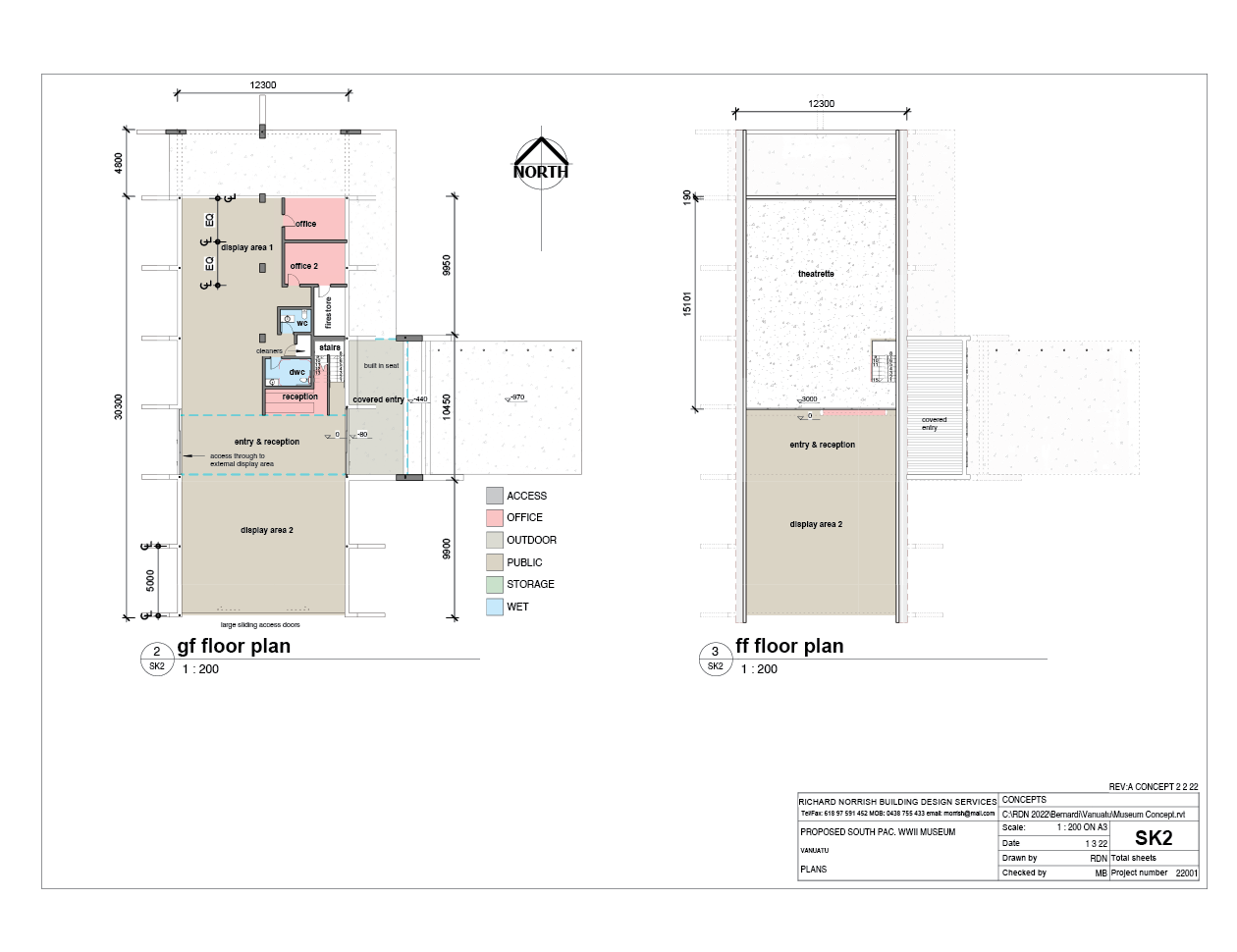
The first step in that vision is what we now call Stage One—the first purpose-built structure in what will become the new South Pacific WWII Museum complex.
Following discussions with long-time museum supporter and former board member Steve Turner in Western Australia, he approached renowned Perth architect Mario Bernardi for his assistance in bringing the first stage to life.
With Mario’s previous experience designing homes on Santo and his passion for off-form concrete construction, he seemed like the perfect person to assist us.
Mario generously agreed to design the building, incorporating exciting contemporary design and environmental principles while maintaining a beautifully simple interpretation on the US Navy WWII Quonset hut—still a feature in and around Luganville.
The main building will be constructed adjacent to the existing Quonset hut slab that dates back to the PT Boat base of WWII.
It includes two levels of exhibition space, including an upstairs meeting area and theatrette.
The off-form concrete construction technique and Colourbond roof will give the building strength and durability in almost any weather. Being raised on a rammed earth foundation will also mitigate high tides and storm surges.
Internal exposed beams will serve as design elements that link the building back to the original WWII Quonset hut.
Unique to the design is the brilliant double-skinned roof that allows air to travel between the two layers, creating a venturi effect that extracts excess heat from the building and reduces the museum’s carbon footprint.
Outside, a smaller Quonset-style structure connected to the main building via a pathway will house the Museum’s LCVP Higgins Boat, protecting it from the weather.
Mario’s Quonset-influenced design dovetails beautifully with the broader master plan for the museum.
The designs were turned into their stunning renderings by European architectural 3D artist Stefan, working with Scott Turner from 99designs in Melbourne.
They both contributed greatly to creating the renders in kind for the museum project, and we are extremely grateful for their assistance.
A place of learning for everyone
From the beginning, this project has been driven by a simple goal: to create a world-class learning experience for the people of Espiritu Santo.
While our current museum has made a strong start, Stage One will significantly expand what we can offer.
Since 2017, students from more than 50 schools have visited our museum. Many arrive knowing little about Santo’s wartime history and leave with a completely new understanding of the role their island, their home played in World War II.
Stage One will allow us to welcome more students, provide improved facilities, and deliver deeper, more engaging learning experiences.
What comes next
Reaching this stage has taken a great deal of work by the Museum Committee.
“The pandemic and Tropical Cyclone Harold set us back,” said Museum Chairman Bradley Wood. “But through perseverance and a shared passion to see the project succeed, we’re now at a very exciting stage.”
The next step for the South Pacific WWII Museum is a major fundraising campaign to raise the funds required to construct Stage One.
As the campaign progresses, updates will be shared across our website and social media channels. In the meantime, we welcome support from anyone who would like to be part of this journey.
Putting our best foot forward
Behind every museum lies a deeper purpose. For the South Pacific WWII Museum, that purpose is not simply to preserve artefacts, but to protect and share one of the most extraordinary — and least understood — stories of the Second World War. During the height of the Pacific conflict, Espiritu Santo became the largest Allied military base in the South Pacific, playing a critical role in the campaigns that helped shape the course of history.
Today, much of that remarkable story remains hidden beneath jungle, scattered across the landscape, or fading from living memory. The museum exists to ensure those stories, places and personal sacrifices are not lost. Through research, preservation, education and the development of a world-class museum experience, the project aims to honour both the local Ni-Vanuatu communities and the thousands of Allied servicemen and women connected to Santo’s wartime history.
Our Case for Support provides a deeper look into the museum’s vision for the future — from the creation of a new purpose-built facility and expanded exhibitions, through to educational programs, tourism development and international historical partnerships. It outlines not only why this project matters, but why preserving this history now is more important than ever.
We invite you to explore the document and discover how the South Pacific WWII Museum is working to transform one of the Pacific’s great untold wartime stories into a lasting legacy for future generations.